Check it out on my Resume page…I’m very excited about my new updated look! I’m old but I still want to change the world, and damn it needs a whole lot of changing!
Wow! I KNOW shit that I didn’t even realize till updating my resume. And as my dear daughter-in-law Steph said, “You’ve done a lot!”
I’ll be submitting story pitches to magazines, journals, newsletters, and publishers. If you, dear readers, have ideas for me or have friends who need a dynamic editor or freelance writer, please let me know. Thank you.
Writing ideas on my mind: Taming the History Wars; How Howard Zinn Changed my Future; Work for the 21st Century, how to include everyone; Brain Science interviews/one with David Eagleman, Stanford prof; possible reprints/updating of my previous articles, such as “The Walking Brain” (Desert Leaf) or “The Heyday of Children’s Bookstores” (Publishers Weekly); Creativity in Septuagenarians; Interviews with the owners of The Children’s Book Shop, Brookline, Massachusetts, currently closing after 45 years in business.
Please write your comments letting me know your thoughts…thanks!
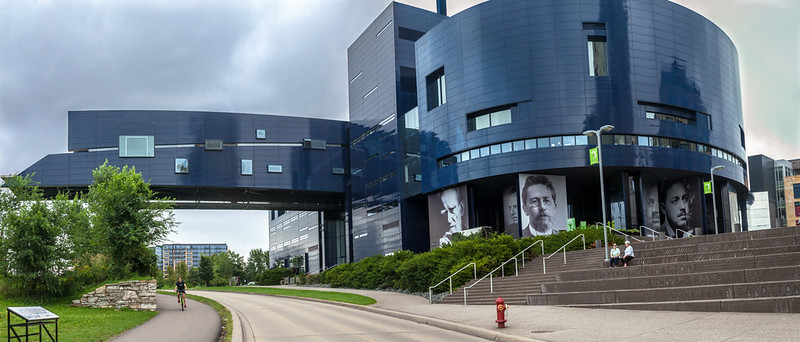
Iconic in its history as the chosen professional theater miles from Broadway, the Guthrie Theater dwells in kindness and joy. What a concept! It’s a premiere arts organization that treats patrons and staff with gratitude.
The Guthrie opened in Minneapolis in 1963. “The idea of a major resident theater was introduced to the American public in a small paragraph on the drama page of The New York Times on September 30, 1959, which invited cities to indicate interest in Sir Tyrone Guthrie’s idea. Seven cities responded: Waltham, Massachusetts; Cleveland; Chicago; Detroit; Milwaukee; San Francisco; and Minneapolis/St. Paul (which was not only interested but eager).” (guthrietheater.org)
My fellow ushers’ backgrounds are as unique as the Guthrie’s avante-garde building: high school kids; young college grads with theater backgrounds; retired teachers, engineers, a human rights consultant, a therapist, and an Apple employee.
The Glorious Guthrie (Flickr)
And there’s a bit of personal history hanging around in this uber-modern building. When my daughter moved to Minneapolis after college graduation in 1999, as a drama and religious studies major, she hoped work at the Guthrie. That didn’t happen. She moved to New York after a year. Here I am serving that familial desire. (She took the religious studies Ph.D route instead, but her theater successes had an enormous impact on her.)
Or as Thornton Wilder, author of the play “Our Town” wrote, “I regard theatre as the greatest art form of all, the most immediate way in which a human being can share with another the sense of what it is to be a human being.”
I’ve never worked in a place quite like the Guthrie. At the end of a two-hour shift overseeing vaccine checks or showing guests to their seats or answering myriad questions. House managers always thank ushers at the end of a shift. Tell us we did a terrific job.
Attending virtual staff meetings is an equitable experience. As an usher — working only ten to twelve hours weekly — I don’t feel anyone pointing to a hierarchy.
Then there are the patrons. A motley crew. I’ve learned a lot about people at the Guthrie, helping theatergoers prior to the performance. A few months ago many people asked, “Where can I get a drink?” Answer: During covid no alcohol or snacks are on sale.
Far and away the most curious thing, to me, is how many people don’t read the signs. Not just older folks but young people, too. “Where do I go?” is a common question despite the giant lit-up sign standing in front of them: PERFORMANCE CHECK-IN.
I used to think we were a nation of readers. No more. I can’t help realizing that conundrum following the election of he-who-shall-not-be-named.
I’ve learned about myself, too. Earlier on in my tenure as an usher a man asked where the coatroom was. When I told him there wasn’t one, he followed up: “What am I supposed to do with my coat?”
I couldn’t help it. “You’ll just have to sit on it,” I replied.
Now I smile more. I apologize. A few nights ago a woman strode up to have her ticket punched. Searching for it, she dropped the contents of her purse.
“This is the most confusing place I’ve ever been,” she complained. Projection? She of course meant, “I’m so confused.”
“I’m so sorry,” I smiled. Poor woman.
Another night an older gentleman tried to give me a one dollar tip for checking his vaccine card.
“Enjoy the show,” I typically say to everyone walking by me. Nearly everyone heading down the hall to the production smiles back, so happy to be there in person following months with the Guthrie closed.
Typically, each human joyfully responds, “I will!”
What a great place to work for an older people-person like me. Besides, I enjoy chatting with Chu and Sierra and Cal about what paths they’ll be scanning next in their young lives.
Meanwhile — Yes to arts education, Yes to gratitude, and Yes to the Guthrie!
Living in three different parts of this country has been a life luxury. Visiting all fifty states has been an education, like getting a Ph.D. in U.S. Travel. My latest trip, to Santa Barbara, California, with my new love, merged a few of my life’s geographic attachments.
Living in Tucson for eighteen years opened the door to a blossoming March. Yes, I miss that. Santa Barbara — with its similar climate and Spanish influence — brought me back to the Southwest.
Photo: Marc Burgett
Wisteria, purple plumes atop an artsy entangled tree stump, thrilled me. Close to lilacs in their glorious color, their fragrance is less intoxicating. But wisteria, just hanging there, are more luxurious in their celebration of spring.
Life returning sprouted the joy of bees buzzing on Mt. Desert Island, which annually surprised me, following ruthless winter gale-force winds stirring the ocean into frothy waves, ice storms knocking out power lines, and snow piled to the top of my garage.
And that’s where I am now, emotionally and physically. I never expected to live in Arctic Minneapolis, here in the Midwest. So when Marc suggested a respite: Santa Barbara hiking, wine-tasting, and attending the Santa Barbara International Film Festival, I jumped in.
Nor did I expect to fall in love with the Pacific Ocean. I referred to it as “the other ocean” in my slightly OCDish way. But there I was, lounging on my rock couch, gazing at and listening to waves rolling over ancient rocks. Reading or writing fell away. Hours at the ocean’s edge felt sacred.
I recalled my friend Martha’s father, in his late 90s, sitting in her car at Seawall watching Atlantic waves roll onto the shore. A favorite activity of his. I empathized.
Here’s the beach across the street from our airbnb.
In sunny Santa Barbara, the Pacific finally seemed friendlier. Gazing at the Channel Islands helped, especially after our visit to the most beautiful island I’ve ever seen (sorry MDI!). Santa Cruz Island, an hour’s boat ride from nearby Ventura, enchanted me.
“I love this so much,” I repeated on a six-mile hike with Marc, who appreciated my happiness.
Santa Cruz Island is the largest of the Channel Islands. Here’s where we ate lunch…
I pictured Earth’s curvature in this photo I took there:
This view comforted me. One week after coming home, I think of a madman’s attempt at the annihilation of Ukraine. I will keep looking at this photo and remind myself of wave-watching solace.
Here we were in this exquisite primitive place. For me a place of exultation. Wishing that all humans could have the same opportunity to visit such a magnificent place.
Two minutes after my daughter texted the news that Ashley Bryan had died my phone rang. It was Alison, one of my two Boston nieces. Her voice announced that something was terribly wrong.
“Aunt Sheila, my mom isn’t going to make it. She’s expected to pass very soon.”
“Oh no, Alison, I’m so sorry,” I said. “I’ll fly there tomorrow to be with your dad.” My brother has Parkinson’s.
Two remarkable people were leaving the planet at the same time. I sensed a connection between Ashley and my sister-in-law. Both were very special kind, capable, optimistic, and very accomplished people. One known globally to children’s book enthusiasts and one known as an extraordinary teacher to family and friends.
Ashley, who was 98, died on Feb. 4. He was one of my role models. Every summer, it was a special treat to board the Islesford ferry behind my house on Seawall Road, bounding down the path through a field of wildflowers, either with my kids when they were young or taking a friend.
Ashley once told my son, “Stand outside singing ‘He’s got the whole world in his hands,’ and I’ll know it’s you.”He always did.
In Ashley’s younger days — say when he was around 90 — he would joyfully meet me at the Islesford dock, calling out, “Welcome Sheila of OZ!” It was thrilling to see his latest paintings and F&G’s of his forthcoming books.
“I know one recipe, for toasted cheese sandwiches,” he would tell me, setting the table with a pitcher of iced tea and plates of various cookies. Usually, someone would arrive at the door with more cookies and join us. “Come in, Friend,” Ashley would say.
Once I asked him how he was always so patient and nice. He replied, “Everyone has given so much love to me, I just want to give it back,”
The last time I visited Ashley in his toy museum home on Islesford…he will be so missed
Sandra E. Borg Wilensky died two hours ago at Massachusetts General Hospital. My sister-in-law touched the lives of so many — not only as a wife, mother, and grandmother, but as an extraordinary educator.
As a first grade teacher she always said, “I can teach anybody to read.” She didn’t go in for phonics or whole language, but what the child needed. Sandra didn’t like labels. She knew what needed to be done. Sandra was a quiet, effective activist.
I recall customers at my OZ Bookstore asking if I was related to Sandra when she was principal at the Merriam School in Acton, Massachusetts. “Wow,” they said. “She is amazing.”
It was Sandra who stayed up all night to make traditional Swedish dishes for a Christmas smorgasbord for around thirty of her family members, complete with tiny Swedish flags.
Who took care of everybody? Sandra did.
She was a stunning watercolorist. Over and over she painted the beauty of beaches she loved — on Cape Cod or Martha’s Vineyard. Each painting was distinctive, evoking the beauty of those places. Really, reflecting her inner beauty.
One of the most impressive things Sandra ever did was teaching thirty-nine hours of art classes online from her hospital bed, following her cancer diagnosis in November. Those classes meant a lot to my daughter over this past year. And to so many others.
Who had the strength to do that? Sandra did. My incomparable sister-in-law. I didn’t see her often enough. Whenever we got together our discussions were honest and meaningful. We weren’t into chitchat over our glasses of Chardonnay.
No prejudice for Sandra either. She hired pardoned murderers to work at her school. My brother was scared for her. Sandra knew it was the right thing to do.
Just yesterday one of my nieces told me that her heart was still beating so strong. She didn’t want to leave this life. Her daughters and one granddaughter stayed in her hospital room the past few days. Their names all started with A, so they called themselves The Three A’s and sang to her, including one of her favorites, a song and dance routine to “The Still of the Night.”
As I’m writing this my nieces are working on an obit of their mother’s incredible contributions to family, education and art for all. No flowers please. Sandra would have wanted that money spent on justice for all (Just Mercy, which I once discussed with her), art education for poor kids, or saving the planet for her granddaughters.
Four generations of Wilensky (Borg) women: Amy holding Lily; Dorothy Borg (who died at 97) and Sandra
Ashley Bryan and Sandra Wilensky were the best of humanity. How lucky I am to have had them in my life.
I don’t know about you but free online deals entice me. Now I realize they can only come to no good. Whether it’s Hulu or Door Dash, The New York Times, or search engine optimizers, I’m done.
Remember the old adage “You get what you pay for?” It’s usually true.
Here’s my story:
On Saturday night, at my guy’s house, I wanted to order in from a Middle Eastern restaurant instead of his neighborhood Thai establishment that we often ordered from.
This was our chance! I had a great online deal from our local food delivery app. A free delivery with my first order’s 30 percent discount lured me.
The app’s communication skills lagged behind my intent. While submitting my order online, “Error” popped up in red. The app somehow recognized my guy’s address and demanded that I use his mobile phone number to place my order.
First I tried calling the preferred restaurant to change the delivery address for the order.
“No, we can’t do that,” the nice restaurateur told me. “You must call the app directly on their 800 number.”
“Oh damn,” I thought. When a young woman finally answered the phone, following recordings that announced, “Your call is important to us,” and some uninteresting piano Muzak, I asked, “Where are you located?”
“Offshore,” she replied.
“But where?” I wasn’t a former journalist for nothing.
She wouldn’t tell me where. “I’m afraid the driver will deliver our dinner to the wrong address.”
“I’ll call the driver and we will settle this confusion,” she said.
“Wait, you’re going to call the driver from ‘somewhere offshore,’ telling him where to deliver our dinner in Minneapolis?”
My guy received a text: “Your driver has arrived.” But we didn’t see anyone outside of his house. He texted back, notifying the driver that he must have gone to my apartment building.
Couldn’t he just come to the correct address?
“I’ll get in trouble if I change the delivery address” without hearing from the other-side-of-the-world app rep, said the minimum-wage delivery man. We gave him a good tip. Poor man with a crappy job.
The offshore rep reached him. Our food arrived after more than an hour’s miscommunications — by laptop, texts, and phone calls.
The food was only okay. Greek salad with shredded iceberg lettuce. Too creamy humus. Too much unflavorful rice and not enough lamb.
Our saga was not over.
Two days later my credit card company reported a fraudulent charge that was too coincidental.
“Someone tried five times to charge $50 to Google ads on your card,” the Visa rep said. Oddly enough, that was the amount of my food app restaurant charge. A new credit card is on its way.
I must pass my Minnesota Class D knowledge test, which wasn’t easy. Previously, I failed it three times Maybe that was because I hadn’t fully studied the driver’s handbook. Ya think?
Perhaps recalcitrant me thought, I’m not going to do what the State wants me to do. I used to crave power. I was a revolutionary.
But passing the test was instructive. I visualized it. I resolved to think through each of the forty questions more carefully, without getting nervous. About a driver’s test, you ask? I hadn’t taken a test in more than fifty years.
Beautiful Lake of the Isles, a half-mile from my apartment, where I spend a lot of time walking. Not at government offices like the Minnesota Department of Motor Vehicles…
But here I am on a snowy day at the Minnesota Department of Motor Vehicles.
And I’m not going to do what the State wants me to do. I’m just not.
But I did.
I only got two questions wrong. I was a winner! I gave the thumbs-up sign to the service reps who had directed me to my test computer.
But I wasn’t prepared to stand in line waiting for a different service rep to hand over a rash of paperwork to fill out.
Because I was a winner.
My first clue that I was different: The bespectacled working woman singles out a small group of Somali women standing in front of me.
Somalis are an ethnic group in the Minneapolis–Saint Paul metropolitan area that makes up the largest Somali diasporas in the United States. By 2018, approximately 43,000 people born in Somalia were living in Minnesota, and approximately 94,000 Minnesotans spoke Somali, Amharic, or a related language at home.
“You’re not listening,” she blares at them, newcomers dressed to the hilt in their good coats, earrings and dressy hats atop their well-coiffed heads. They were respectful, meeting up with American bureaucracy.
“Maybe they don’t understand what you’re saying,” I retaliate. A former Somali-American woman dressed in jeans, who spoke fluent English, accompanied the newcomers. We chat. She came from Ohio. I tell her I had moved from Tucson to participate more in my grandchildren’s lives.
The working woman leads the newcomers into the inner chamber of the Minnesota Department of Motor Vehicles.
A short security officer admonishes the rest of us waiting in the impossibly long line in the hallway outside of the important DVM activity: “Stand outside the door in single file. Single file only, don’t go inside until you’re called.”
“This is such bullshit,” mumbles a young, possibly 7-foot tall Black man with dreadlocks. “I wouldn’t be here if I didn’t need an ID.”
“Yeah, that little security man (who was also Black, as were most of my compadres in the line) needs something to do. Makes him feel powerful, I guess.”
A very large woman behind me, wearing a pancake velvet hat, pipes up: “I was just telling my husband the same thing. It’s a little bit of power.”
Oh yeah. We all chuckle. The would-be basketball star young man is still mumbling to himself.
A young woman with turquoise clumps of hair who looks like a trucker storms out of the DMV inner sanctum carrying wads of applications.
“The U.S. government is rotten through and through. Fuck them,” she bellows, stomping up the stairs.
Suddenly, the working woman gets down from her perch again. Emerging into the hallway she removes her glasses and stares at the line of humanity. I’m next in line. Disputing the short security man’s instructions, she tells me, “Get behind the door. Just watch through the glass window for me to wave you in. Don’t come inside until I do so.”
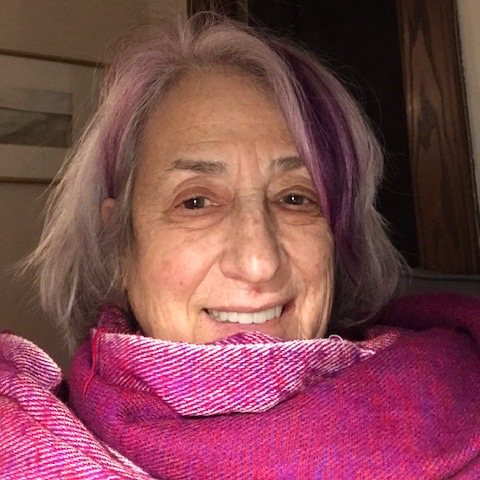
“What if I can’t see you waving me in?” I ask. Guess I’m ready for an argument, standing up for all those behind me who wouldn’t dare. They know what it’s like to grapple with authority. I take my chances. I’m an old white woman with purple hair.
“She’s waving you in,” the tall guy taps me on the back to let me know.
“That’s demeaning to wave people in like that, like they’re a herd of cattle,” I say to the working woman sitting back at her perch.
She doesn’t yell at me like she did at the Somali women.
“What can I do for you?” the working woman politely asks. I tell her and she hands me the appropriate papers to fill out, which I do. A nice Somali-American man calls me up to window 10. Super efficient, he is.
He hands over my new license plates. “That will be $137,” he says. “Welcome to big tax Minnesota.” I feel a pang of sadness. My old Arizona license plate will hang under my former Maine plate in my apartment bathroom. Part of the decor.
Perhaps I didn’t want to give up my Arizona license plate with its purple saguaro against a colorful desert background. My Arizona life rests firmly in the past. Minnesota blue license plates will match my ocean blue Toyota Prius.
I’ve lived in three different parts of the country. Because I can.
I have the luxury of owning a car. Of procuring a free global entry card with my Visa credit card that piles up travel points. Someday after covid dies, before I die, I intend to travel to Sicily.
I’m looking for more work from home. The fabulous Guthrie Theater is on hiatus till March due to covid. So I’m thinking…
Do you know anyone who needs a top-notch editor (ME!)?
Have you thought about starting a blog?
You don’t have time or you don’t know where to begin? As an experienced blogger I can help.
Here’s my one-month offer: $350 for four weekly, 300-word blog posts
What would you like to promote? A sustainable product, an idea or project, you name it. I started blogging in 2010 when I worked as a journalist.
At that time, many individuals referred to themselves as “Citizen Journalists.” Pushing their opinions wasn’t journalism. I needed to say something. And I’ve been blogging ever since.
Weekly blog posts are an effective mode of communication:
A blog is a platform for you to share valuable content with your audience.
A blog can help you clarify what’s important about whatever you’re promoting. It provides useful information that your clients or audience would appreciate knowing.
Blogging keeps you in mind. You never know what a person may remember, and what may encourage that person to contact you.
Readers will look forward to your posts (that’s what I’ve heard!).
And perhaps most beneficial, what you have to say is getting out there.
What do you care most about – in life and in work? Blog it!
*If you would like to discuss possibilities for blogging or editing please email me at sheilawilensky@gmail.com.
** And now I’m off for my daily walk around Lake of the Isles.
Walking around Lake of the Isles last week I pulled my scarf up over my mouth. I’d never done that before but that’s how they do here. I’m starting to feel like a local, as my scarf blocked the cold wind pummeling my face.
Lake of the Isles
Woven lovingly of the softest silk and wool by my island friend Lucy Tracy, the scarf’s comforting warmth reminds me of everyone who ever worked with me at OZ Books, my bookstore in Southwest Harbor, Maine, from 1982 to 1997. The Ozettes gave me the scarf for my 50th birthday.
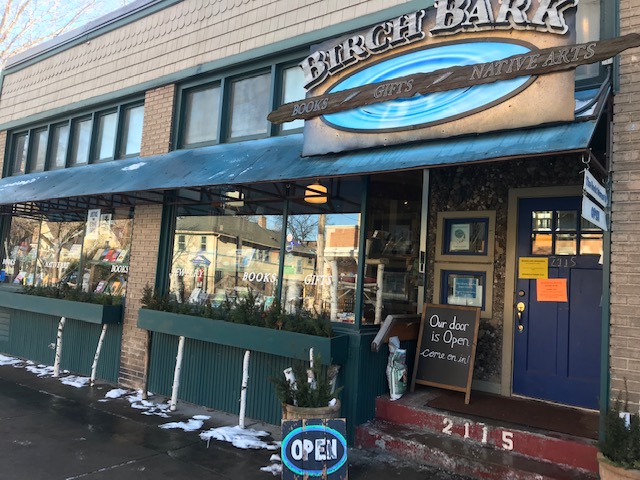
As a former sister bookseller I was drawn to Louise Erdrich’s latest novel, The Sentence. It takes place at her Birchbark Books, halfway around Lake of the Isles. Hers is the bookstore that reminds me most of my OZ Books. It has a purpose beyond making money, the same way OZ did highlighting kids’ books on history and social justice.
Erdrich, a member of the Turtle Mountain Band of Chippewa, focuses her twenty-year-old store on books by and about indigenous people.
I couldn’t wait to read her new book. I empathized with her, although I had never read any of her acclaimed books.
There was so much I didn’t know.
I purchased The Sentence. It so resonated with me, from its main character Tookie’s plight as a bookseller, to ghost customer Flora’s permutation of the story, to the inclusion of present-day politics such as the murder of George Floyd, and life under the pandemic,
Tookie conjured up my own blurting: “Well, tough shit,” she tells the doctor, who insists she leave her covid-struck husband Pollux in the hospital. “I’m staying,” says Tookie, who’s such a complex character.
Pollux’s and Tookie’s backstory injects a ton of intrigue into the story. But then, every character comes alive in Erdrich’s artful storytelling.
Tookie cares deeply about her bookstore customers, which is partly why Flora the bookstore ghost so consumes her. Referring to one customer as “Dissatisfaction,” Tookie prides herself on finding the perfect books for him.
Sound familiar, dear independent booksellers? Has anyone else’s bookstore been haunted?
“The world is haunted,” writes Erdrich.
Pollux is such a calm, comic relief to the many twists and turns in this novel. Additionally, the understated humor, abundant love, and power of books (see the incredible list of titles at the end) shine through.
The Sentence brought me closer to Minneapolis and its fraught history involving indigenous peoples. The Dakota War? I knew nothing about it.
The novel also urged me closer to native spirituality. Why do I immediately smudge every new place I’ve ever lived, which got me thinking about friends who tell me I’m spiritual.
“Nah, not me,” I’ve been known to respond.
The book’s title is also a conundrum. When Tookie tells Erdrich, who is a character in the book, “What I’m trying to say is that a certain sentence of the [mysterious] book — a written sentence, a very powerful sentence, killed Flora.”
“I wish I could write a sentence like that,” replies Erdrich, in character.
In reality, Erdrich’s delicious sentences grabbed me. They wouldn’t let go.
Erdrich became my friend, which doesn’t happen to me often while reading a novel. I loved the questions Tookie asked herself. I loved Erdrich’s perspective as the bookstore owner. I loved everything about this book.
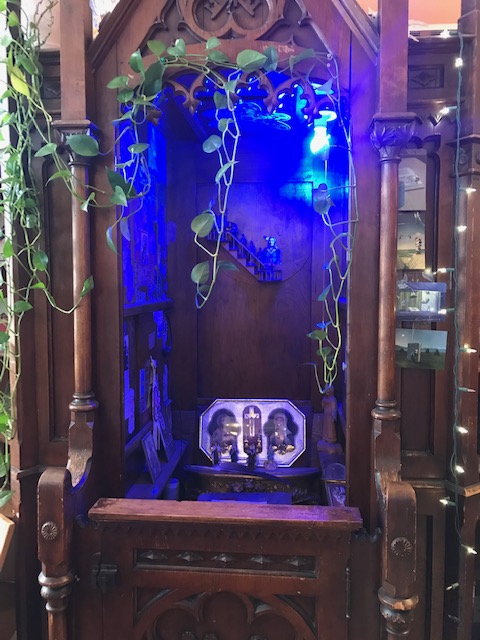
A priestly confession box in a bookstore, holy moly!
Today I walked back to Birchbark Books to buy a copy of Braiding Sweetgrass. How lucky am I to have a terrific little bookstore only a half-mile from my apartment. It was a sunshiny day with the temperature in the high 30s. And I had to take another look at that priestly confession box, which serves an important role in The Sentence.
A whirlwind hit the Minnesota Children’s Museum around 11 a.m. yesterday morning. Foss, my nearly five-year-old grandson, pushed the button to open the museum’s doors.
Like a puppy sniffing his way around he was hell-bent on running into every corner of the three-story building.
“You have to tell SheShe where you’re going next,” I tell him, following close behind. When he doesn’t stop at the humungous Lego room I guess where his first stop will be. Longer than two seconds. Yep, it’s the pseudo post office on the top floor.
I have no idea why but it’s where he spends the most time on every museum visit. It seems monotonous to me. He loads boxes onto an automatic chute, then runs upstairs to send them down another chute. Again and again. I sit on the stairs for a rest.
I figure it’s Foss’s place to decide what he wants to do. He gets into a zone that I don’t understand.
That’s why I’m here in Minneapolis, to participate in my grandchildren’s lives. To watch them grow in their own ways.
Anyone who knows me knows how much I love conversation. At his advancing age Foss is capable of having real conversations, which delight me.
He has a supersized memory: “SheShe, you promised to take me to the desert.” Following some negotiation, I agree to take him to Tucson for his seventh birthday present. He will remind me, I’m sure.
He helps me with directions and when I can’t find things: “I think you put a mask in that soft place (the console between the two passenger seats of my car).” Looking for my car in the parking garage yesterday, he reminds me, “We’re on level three. We’ll see your ocean blue Prius when we get there, SheShe.”
He teaches me stuff: “Did you know that bugs poop in the dirt? And they pee there, too.”
He doesn’t hold back: “SheShe, you need to get more toys at your apartment for me. And milk, too.”
He’s a quick learner: Foss figures out how to keep the museum’s laser room replenished with green lines going every which way, so there was no more waiting your turn to enter. Everyone could go in at the same time.
After one try at squeezing myself under and above the green laser lines, bumping into kids of all sizes, I remove myself from the exhibit.
“I’m exhausted,” another grandparent announces, as we both listen to the amused yelling inside the laser exhibit. I felt the same way, thinking of the kids inside as a pack of fuzzy-haired creatures.
Foss finally emerges from the pack. “I want to go now,” he says, following two hours of kid car washing, water play, climbing up four stories of ropes and coming down the twisty silver slide, ping-pong ball shooting, Lego and laser frolicking.
A highlight of our trip to the Children’s Museum: Foss offers another boy a Lego: “Let’s build a house together.”
A balanced life is knowing that most of it is over, without morose or dwelling in the useless land of regrets. “A Balanced Life” is the name of a Pilates website I follow. Young Robin Long, the mother of four babies under four, has figured out how to sit on the Santa Barbara beach teaching snippets of Pilates: five minutes and eleven seconds stretching, eleven minutes of a full-body workout; seven minutes to strengthen your pelvic floor.
And it will all matter, says this exuberant mother of four. At her age I didn’t realize that short spurts of exercise would change my life, that I needed to not work so hard at OZ Books, that my then husband and I should have reserved a few weekends for ourselves?
A balanced life matters in old age, too. Maybe even more so. We’re all going to die. Prior to the grim reaper kidnapping me I intend to live. Do my happiest days lie ahead? Perhaps.
Here’s what I mean: My dear friend Claire made a quick visit from Maine to my new home in Minneapolis last week. Claire and I are a lot alike. A few years ago we traveled to Southern France together. Go, go, go was our mantra. Agog with the scenery, the weird twisted trees, the luscious baguettes, nature walks down old dirt roads, we had to do it all.
Exhausted, we returned to our room at Bastide St. Didier, stumbled onto our respective twin beds (the French are so smart, king-size beds can be maneuvered apart for singles like us). It was quiet time, with velvety breezes crossing the room through an open window above an ancient vineyard.
Go, go, go was our mantra in Minneapolis last week, too. Walk around Lake of the Isles, mesmerized by the gold and orange leaves on the turning trees. Dinner that first night at Spoon and Stable, one of Minneapolis’s finest restaurants. Just the beginning of lots of laughter and fun with our third companion, Marc, an old friend of Claire and Jay’s and a new friend of mine.
The day before heading home Claire said, “I’ve got to go to George Floyd Plaza. Can’t visit Minneapolis without doing that.”
“Let’s do it,” I say.
Walking down Chicago Avenue I recalled the same sad stroll with my son, Ethan, and grandson, Foss, a few months ago. Staring at eighty names of Black individuals who were killed by the Minneapolis police, Foss asked, “What do all those words written in chalk say?”
Black Power! Power to the People! Let the truth be heard!
Nothing has changed since then. Last week Claire and I quietly hung out at the George Floyd memorial, strewn with flowers and notes in front of Cup Foods, where Floyd’s life was squeezed out of him. I started chatting with a young Black woman about Emmett Till’s grotesque murder for glancing — at age fourteen, in 1955 — at a white woman. That set me off on my typical U.S. History rant, the theme being: “What happened to truth?” I felt sad and angry.
Claire and I left the scene. Returning to my car I posed in front of the statue, raising my fist in the Black Power stance. Hoping it might reduce the stress of all those unnecessary killings.
When we drove by Cup Foods I notice that beautiful young Black woman. Raising her fist. I felt better.
Claire and I needed a balancing act. We headed toward StevenBe’s knitting shop down Chicago Avenue. I loved the place, run by two wacky gay guys. Knitting is meditative. Making warm, cheerful hats and scarves for people I care about can only help.
I have a lot to say. Some of it is pretty insightful. Not all of it. As a journalist I do more formal writing; this blog will be informal. Let me know what you think