I’m so dismayed by the banning and censoring of children’s books I’m going to recommend new titles as often as I have a few minutes: First is The Giver by Lois Lowry, published in 1993.
One of my all-time favorites, The Giver, has been banned, censored, and/or removed from libraries/schools/reading lists more than 11,000 times.
Why? There are some mild sexual references.
But The Giver reminds me of what’s happening in our country today: fascist elements. There’s no other way to say it.
One person in the book is the repository of all history. Damn, you know, the truth is just too uncomfortable. That person is chosen at age 12, like Jonas, is the ONE whose story this tells.
All other twelve year olds receive their life assignment at that time, too. No questioning. Does this sound familiar in our current world? Republican Party members must be totally adherent to he-who -must-not-be-names.
There’s no color or conflict or poverty or unemployment or injustice in Jonas’s world. Just as cult Republicans must be in denial of all their untruths and craziness.
If you’ve never read this fantastically prescient and provocative — YES! — book, I highly recommend it. Let me know what you think (the key word, THINK, WHICH WE NEED SO MUCH MORE OF IN TODAY’S FORLORN SOCIETY.
Popping wild blueberries into my mouth, gorging on the sweetest tiny raspberries ever, is a thrill for this woods woman, this lover of nature.
We’re here for the week with Marc’s family at Northern Air cabins in Ely, Minnesota. A far cry from the exorbitant heat in the Twin Cities. It has rained all week. Last night it poured, offering soothing sounds in the North Woods darkness.
Like in Maine, where I’m from, wild blueberries make me happy. They’re tiny this year, having kept to themselves in the drought. Until this week.
I usually think: Wow, if only I could read books nonstop in a lovely spot, which is what happened during this past week. Finished two books, half-finished two others. As much as I love reading I was a little bored hanging out inside.
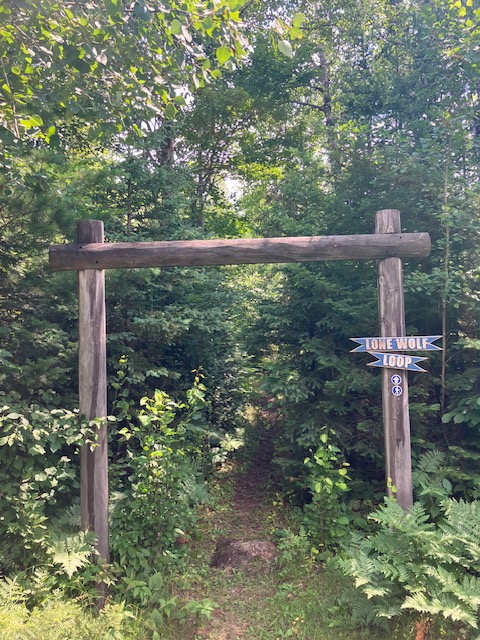
The Lone Wolf Loop, a 45-minute hike on the property where we’re staying, speaks to me. On today’s one-hour hike I experienced a small epiphany.
When I was fifteen, my father was partially paralyzed. He lived in a rehab center in Shelton, Connecticut, about 40 minutes from our Waterbury home. My mother didn’t drive. I illegally drove her twice weekly to see my dad, when I wasn’t working as a cashier at a discount department store or folding children’s clothes in a retail store.
My father was in his sixties and had had a cerebral hemorrhage. Young men paralyzed from motorcycle accidents, or who knows what, filled a number of other beds. This was totally depressing to someone my age, just starting out in life, imagining all that could happen over the years.
My only way out was walking around the rehab center’s wooded property, which harbored broken men like fallen tree branches. Saved me. Saved me. Saved me.
Hiking with imagined wolves following me this morning, it hit me. Being alone in nature, surrounded by ferns of all sizes, assorted leaves blowing in the breeze, and tasty wild blueberry patches, still sustains me.
Writing fewer blog posts, more remiss paying attention to human-induced climate change.
Sure, I worry about my grown kids’ future, my beloved grandchildren, and all of Earth’s children.
What can I do? I ask myself. I write. I’ll tell you about a superb 800 page-plus novel that sheds light on rising sea-level disasters, increased world-wide poverty and starvation, and a world of issues hindering life on this still beautiful blue sphere.
THE DELUGE by Stephen Markley is well worth reading. Too bad it’s so long, scaring many intrepid book lovers off (including my partner).
I’ll admit, I don’t read every word: the prerogative of older readers. We only have so much time to read!
It’s a page-turner that terrifies me: with its crackling scientific minutiae; its sci-fi premonitions; its government ineptitude and political wackos.
Projecting into the next thirty years or so, the book’s possibilities ring true. Perhaps some solutions lie within, too, but that’s not for me to say.
Kate Morris, THE DELUGE’S major protagonist/activist with the wild hair, enthralls me (and her longtime partner). Activists who risk everything always do, but that’s not my approach either.
Is there any hope? I’m intrigued by big carbon and other taxes, by policy geniuses who will stop at nothing, about a possible reordering of political movements.
Will we get there? I don’t know.
What I like best about THE DELUGE is it makes me think. A lot.
Are substitute teachers more dangerous than people carrying guns in public?
Having just submitted a substitute teaching application to the State of Minnesota, which required a background check through finger printing and pages of questions about convictions for drug or sex trafficking, I can’t help but ponder:
Does the State of Minnesota have uniform licensing requirements for gun ownership? No.
Does the State of Minnesota have uniform licensing requirements for substitute teachers? Yes.
Strict licensing requirements for both are essential.
“Minnesota does not require a license to purchase or possess firearms. Persons who wish to purchase a handgun or semiautomatic military-style assault weapon may apply to [their] local chief of police or county sheriff for a transferee permit, although a transferee permit is not required for the purchase or transfer of such weapons” (Giffords.org).
“Thoughts and prayers” will not make a society safer when there are more guns than people.
Stricter gun licensing requirements may be a start. Standing up to the gun lobby may be a start. Appealing to NRA members, who agree that stricter gun licensing requirements are necessary, may be a start.
For more information to help reduce gun violence, please visit: Giffords.org or Momsdemandaction.org.
We’re in deep trouble. Discussing past historical horrors is horrendous in itself. Avoidance and lies only cause more trouble.
Consider the plight of my favorite Constitutional Amendment, the Fourteenth: “No state…shall deny to any person within its jurisdiction the equal protection of the laws.” Ratified in 1868, the essence of the Fourteenth Amendment has been tossed to the wind, although it’s the framework for any semblance of American democracy.
Throwing out the evils of the past will not save democracy. Returning to the restrictions of voting rights will only inhibit progress into a clearly multicultural U.S. future. For those who deny this fact, “the objective is to win the war against progress and to freeze America in a yesteryear image of itself,” writes New York Times columnist Charles Blow.
Yes, it took a century for Civil Rights legislation to finally pass in 1964. Despite the Fourteenth Amendment, the United States still required Congress to comply. For the first time, many Black citizens strode to the polls to vote — unafraid of recrimination — or worse.
The Fourteenth Amendment directed the U.S. Supreme Court to allow same-sex marriage in Obergefell V. Hodges (June 2015).
Truth has disappeared from our body politic like sugar water gulped by hummingbirds. Buzzing around so fast, without any evidence, lies are mistaken for truth. Social media sound bites whiz in and out of our brains.
Back in the 1990s, I told my Mt. Desert Island, Maine, high school students, “If you see me walking down the street thirty years from now what will you say?”
You would yell, Equal protection of the laws!The Fourteenth Amendment!
There is no semblance of democracy without it.
Consider the current plight of my favorite Amendment:
The NYT Magazine’s 1619 Project, which seeks to “reframe the country’s history by placing the consequences of slavery and the contributions of Black Americans at the very center of our national narrative” created a right-wing backlash, instigated by former president Donald Trump’s “1776 Report” touting extreme patriotism, i.e. leaving out Blacks and minorities.
Weren’t we all immigrants who settled here, other than Native Americans? (“The End of History,” NYT, Jan. 15, 2023.)
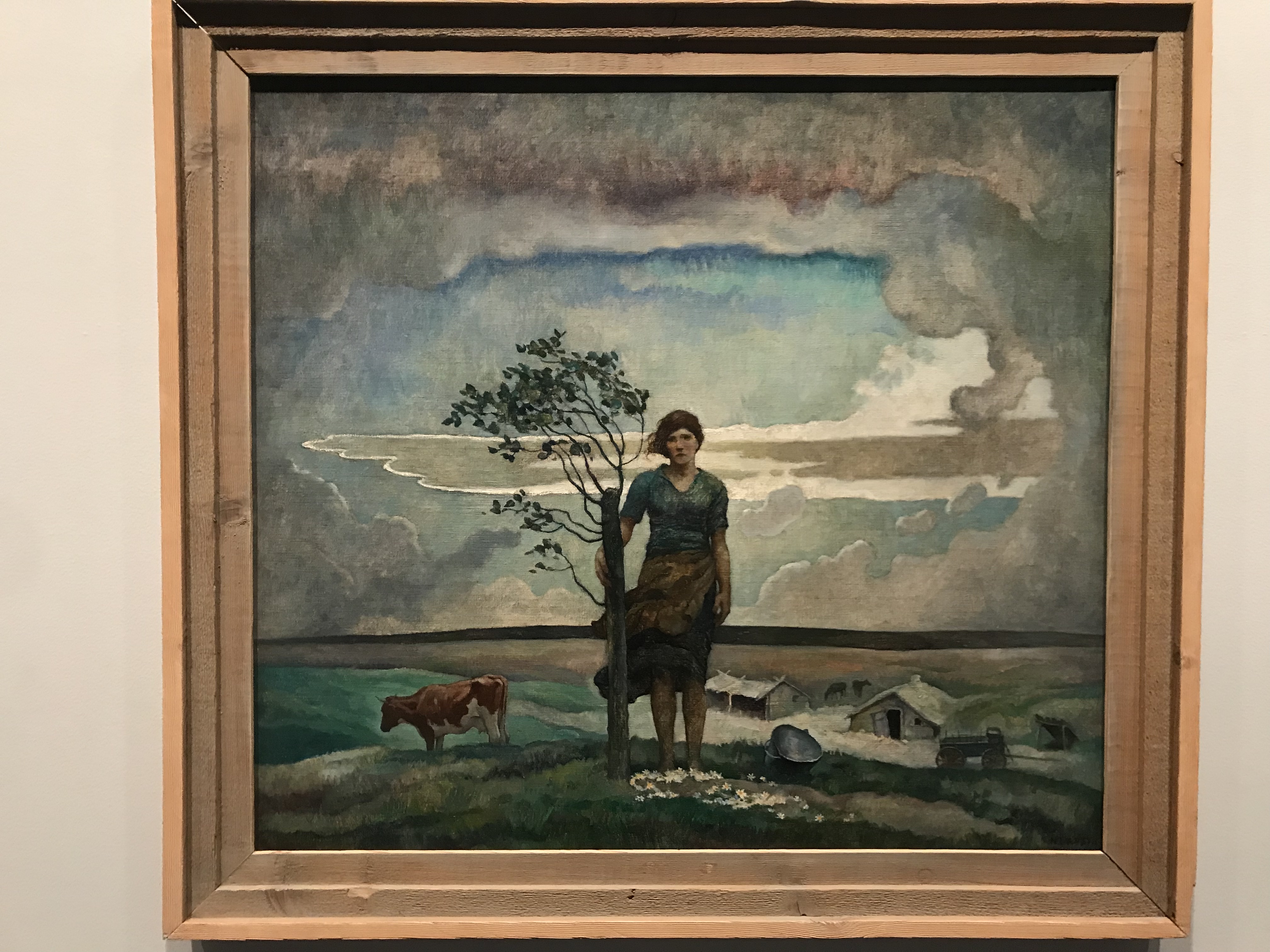
A pioneer white survivor by ONE OF THE WYETHS, Wichita Art Museum
There are bright spots.
At the end of 2022, a federal judge blocked Florida from enforcing the Stop Wrongs Against Our Kids and Employees Act (Stop W.O.K.E. Act) in the state’s colleges and universities.
The order came in a lawsuit brought by the American Civil Liberties Union filed on behalf of seven instructors and one student in colleges across Florida to challenge the Act, which limits how “systematic” [a word critical race theory deniers particularly abhor] racism and sex discrimination can be discussed in schools or workplaces.
In Florida, the ACLU argued the law violated the First and Fourteenth Amendments because it restricts instructors and teachers from learning certain viewpoints.
“Parents and caregivers are children’s first teachers and play a powerful role in determining what children learn about history and in shaping children’s perspectives and our shared future. Discussing the history of slavery in age-appropriate ways can help children understand how that history influences life today.
The Southern Poverty Law Center’s new “Learning for Justice” guide, Talking to Children About the History of slavery in the United States: A Resource for Parents and Caregivers, compiles a list of recommendations for talking about slavery and race with children, offering age-appropriate information and resources to emphasize in conversations and in classrooms.”
Eliminating key parts of our history for bogus reasons — like learning historical truths will make children uncomfortable – is a misuse of the Fourteenth Amendment.
On February 9, the Washington Post’s Laura Meckler reported that the College Board removed the mention of Black Lives Matter and reparations for slavery’s harm to descendants in its African American History pilot program, at the same time stating in a letter to the Florida Department of Education the “the changes were not made in response o Florida’s complaint.”
Meanwhile, more than sixteen states are considering “Do Not Say Gay” laws.
To forge a true democracy, the Fourteenth Amendment must rule. “Democracy sprouts in public schools, where students grapple, together, with our messy history and learn to negotiate differences.” (“What Are Schools For?” NYT, September 4, 2022) No state or jurisdiction may deny to any person “equal protection of the laws.” PERIOD.
I love being in Tucson, where the saguaros welcome us on the edge of Gates Pass. The mornings have been chilly. But by noon the sun shines down on the back patio. A trickling waterfall soothes me with one of my favorite sounds on Earth. Water. Immersed in the desert sunshine. Sparkling city lights at night. The Tucson mountains greeting us at all hours. Sunset ribbons of pink hovering over darkening mountain silhouettes every evening.
We’re not in Arctic Minneapolis anymore. One more month of Tucson magic.
Our daily mantra: Write; Hike; Read.
WRITE: I’m working on an essay about the end of history education. Neglected truths. “Alternative facts??” Dismal historical and civic knowledge. Once a history teacher, always a history teacher!
HIKE: Yesterday we hiked Brown Mountain, another new one for me.
I’m feeling very fit, realizing how tough it is for me to be housebound in the Minneapolis ice and snow. Not to mention frigid temperatures. Before we left in late December, I just had to get out and walk. Slipping as I crossed the street I fell on the back of my head. Yikes.
No concussion as far as I can tell. My brain seems the same — words disappearing in a flash, memory loss, more fatigue with every year over seventy. But I’m grateful for every hike we take.
READ: “The Signature of All Things” by Elizabeth Gilbert, that’s my Minneapolis book club reading. The saga of Alma Whittaker enthralls me. I have around one hundred pages left before we zoom this week to include me in the discussion. I’m grateful to my new reader friends.
Happily, the book is definitely not “Eat. Pray. Love.” I highly recommend it, the life story of a wealthy Philadelphia botanist creeping into spinsterhood in the first half of the nineteenth century. I’m expecting that the final section will lead me to an even greater appreciation of Alma’s life: her courage; her curiosity; her doubts; her confidence and her anxiety.
Meanwhile, I’m hugging myself amid all the friendly saguaros (my man accompanied me for two miles on yesterday’s hike). Three big ups and three big downs starting up the trail behind me, totaling around 800 feet of elevation, 5.3 miles (see the previous photo to one of the tops).
Diverse saguaro personalities cheered me on along the way. Like my Tucson human friends. It’s so different being here on the west side of the city, exploring new hikes while trekking up old favorites like Rattlesnake Canyon and Douglas Springs.
I’ve never hiked Phoneline Trail in Sabino Canyon. Tucson pals, anyone want to go with me?
Heading out of Minnesota Wednesday morning reminded me of the precarious black ice that threatened new young drivers on their way to and from Mt. Desert Island High School.
“Watch out for black ice” was my constant winter warning.
Yesterday we witnessed at least a dozen cars and trucks flying off the road, a few right before our eyes. Piloted off the highway like paper airplanes.
Twenty years later, black ice still threatens drivers. This time it was older drivers like us. We made it out of Minnesota safely. Away from the snow. Away from the ice.
I’m thrilled to report that our down jackets are packed away until late February, when we’ll return to Arctic Minneapolis.
Yesterday’s twelve-hour driving day transported us to Wichita, Kansas. It was in the mid-50s.
But we needed a respite Thursday morning.
Thanks to Tucson writing group friends Ron and Leslie, who urged me to visit the Wichita Art Museum.
What a dreamy, uplifting interlude! N.C. Wyeth, Edward Hopper, Thomas Eakins, Jean Marin, Diego,Rivera, Marsden Hartley. (Where were the women?)
I think this N.C. Wyeth was my favorite. A young widow out on the prairie alone.
Plenty of Maine paintings were on view, including Marsden Hartley’s “End of the Hurricane.” Most were new to me, never appearing in any books or other exhibits I’ve seen.
Along with a few of Edward Hopper’s mysterious New York paintings:
The Wichita Art Museum is an educational mecca. An ideal opportunity for children to create imaginative stories about art. A special living room with small tables and chairs invited kids to exercise their imaginations.
The museum is such a welcoming, glorious place for all ages:
This cheerful Dale Chihuly design greeted us in the upstairs lobby.
Today we drive on to Albuquerque, where we’ll visit my friends Marla and Mark (I haven’t seen them since my first night out of Tucson on my way to live in Minneapolis in July 2021.)
On Saturday it’s on to my former home in the Sonoran desert! To saguaro cacti! To geckos doing push-ups!
We’ll get to celebrate New Year’s Eve with my oldest dear Tucson friend.
We’re lucky. A fabulous art museum, old friends, and a two-month respite in the sunshine.
It’s the questions, Stupid! Back in Bill Clinton’s day it was “It’s the economy, Stupid!
That’s not the case anymore. We’ve gotten ourselves mucked up with too much political hypocrisy, lies, and general incompetence. (Look at Herschel Walker, an incompetent projected by Republicans onto the Georgia political scene to become an Uncle Tom.)
Democracy is about learning to ask questions. Furthering any discussion by listening and engaging with more questions.
That’s what I always thought, first as a high school social studies teacher, then as a journalist. You can always look up an answer: Who cares how many historical dates one can rattle off?
We have the Internet, the greatest information gatherer in history!
I’m in good company.
Recalling my interview with “Democracy Now” host Amy Goodman, years ago, she talked about the importance of discussing/debating public issues around the dining room table. That’s how it was growing up in her family.
“Anything less is a disservice to our society,” she has said (I can’t find my old article that appeared in the Arizona Jewish Post.)
Amy Goodman on the set of her progressive radio show, “Democracy Now”
Disservices to our society are more widespread these days. A Georgia U.S. Senate candidate who stated “I would rather be a werewolf” than a vampire? (Check out former President Barack Obama’s witty comeback)?
In this “important” exchange, said Walker, Obama had taken his remark out of context.
Consider Alabama Senator Tommy Tuberville, a former football coach who “misidentified the three branches of government as ‘the House, the Senate and the executive’ in an interview with the Alabama Daily News, following his election in November 2020.
Here’s an essential question: Why would any American want to be represented by a senator with little knowledge or consideration of how government works?
Please teach your kids questions that make them think! Not just identifying the three branches of government, but what do they do? What policies would you want your senators to pursue?
I was one of the lucky ones. I lived in modern times.
It wasn’t easy opting for an abortion on Nov. 22, 1984. That day wasn’t a happy one. It emphasized another reason to dislike that November day, the first being JFK’s assassination in 1963.
Women must speak up about having had an abortion. That’s how I feel.
My ex-husband and I already had two children we adored. Starting a new chapter in my life, opening the OZ children’s Bookstore, excited me. Having a third child did not. I couldn’t do it.
Still, I occasionally grieve for that fetus I imagined becoming a second magnificent daughter. One I would have named Emma.
It wasn’t an easy decision to have an abortion. To his credit, my ex recognized that it was mine to make. He could have gone either way.
Judaism recognizes that “life is breath.” I don’t follow my hereditary Jewish religion, or any religion, but I sometimes feel proud of “Jewish law.”
Does Jewish law state that life begins at conception? No, life does not begin at conception under Jewish law. Sources in the Talmud note that the fetus is “mere water” before 40 days of gestation. Following this period, the fetus is considered a physical part of the pregnant individual’s body, not yet having life of its own or independent rights. The fetus is not viewed as separate from the parent’s body until birth begins and the first breath of oxygen into the lungs allows the soul to enter the body. (National Council of Jewish Women)
So why are all women in the United States now forced to follow a primarily Catholic or Evangelical decision about their bodies? The U.S. Supreme Court’s biased Dobbs ruling is untenable.
I have a lot to say. Some of it is pretty insightful. Not all of it. As a journalist I do more formal writing; this blog will be informal. Let me know what you think