Once I locked myself in the bathroom, planning to jump out the window, swinging on a tree branch like Tarzan or Jane in old jungle movies. I was young then.
Never before had I been locked in the bathroom by mistake. I had just taken a shower and was looking forward to our December Linden Hills Ladies Libation event.
As I nonchalantly went to open the bathroom door the old-fashioned glass doorknob fell off. No screw showed up to hook it back in place. I was stuck. Nail files, tiny scissors, and anything else sharp I could fit in the empty space, where the doorknob had lived, proved frustrating to use as escape items.
I took breaks from poking around in the doorknob inners. Squats, leg lifts, donkey kicks, and myriad exercises ensued. As did fingernail and toenail clipping. I found a bottle of nail strengthener to apply to my fingernails. I attempted meditation. That didn’t work.
“Remain calm,” I told myself.
My friend Judy arrived to pick me up for the ladies’ event. She rang the doorbell. Usually I’m standing outside when she drives us to parts of the city I’m unfamiliar with. We joke about going out drinking, and the time I drove over a curb following TWO glasses of Prosecco.
“Help, help!” I cried. “Come downstairs, I’m locked in the bathroom.” She didn’t hear me.
“Maybe I would have heard you if I came to the side door,” Judy opined. She called Marc to alert him, or indeed, to discover if both of us had befallen to “a situation.” He didn’t answer his phone.
Speculation arose among the Ladies Libration members.
“Did Sheila have a heart attack?
“Are they in the hospital (I sure hope they weren’t going to start calling every hospital in town).”.
“Did their house burn down?”
My LL friends were concerned. Apparently, they entertained themselves with their own locked out/or in stories.
Two hours later, when Marc returned from his dog psychologist appointment with Barkly, I called the ladies to tell them what happened.
I heard the laughter in the background when someone announced my plight.
From now on I will take my phone into the bathroom, just not in the shower, of course. I will leave a book there, adding to the places I never go without someone else’s story beside me.
Why am I surprised after visiting an art museum? Those feelings of newness, imagination, and life’s possibilities bubble up in me every time. Yet how often do I go to an art museum, of which there are three top-notch examples here in Minneapolis?
Yesterday we ventured to The Museum of Russian Art, the only museum solely exhibiting Russian works in North America.
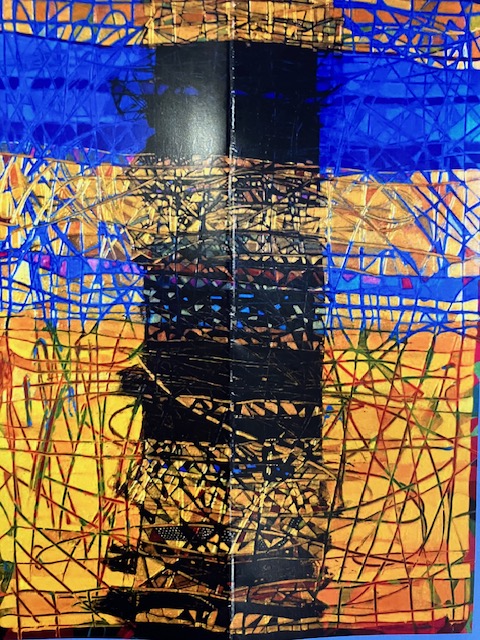
In the brochure depicting The Art of Leon Hushcha, raised in a St. Paul Ukrainian-speaking family, the artist says, “When words fail me, I paint.”
His gleaming, diverse paintings speak to me about: Putin’s decimation of Hushcha’s home country, where I believe my mother was also born; the Ukrainian heart and soul; and the artist’s love of color, ultimately jolting me into pondering a local artist friend’s recent question.
Sorry for the light flash in this magnificent painting
How do we balance both joy and grief in our tender psyches?
Our last day in Sicily, we four tourists were lounging on Cefalu’s crowded beach. The Mediterranean beckoned. I fell for it big time. Its turquoise clarity colliding with other shades of blue, matching the sky. The Mediterranean’s gently rolling waves were supposed to relax us before boarding the long flight across the big pond, back to Boston and our daily lives filled with errands, writing, walking, coffee, and adorable grandchildren.
The young entrepreneur with curly dark hair walked by. Patterned Indian beach blankets, or tablecloths, piled high in his backpack propelled him forward. Bogging him down with financial responsibility. His dark eyes sparkled.
“Look,” he pointed to one of his blankets, shaking the sand off. He proved his case. Always smiling.
I wondered about his background. Was he Sicilian, or had he relocated as an immigrant from some war-ravaged country? And, how did he procure his wares? As a former journalist, I’m permanently curious.
“Bellissimo!” we four travelers announced. Somehow the entrepreneur heard us. Or he intuited how undecided we were about buying one of his blankets. Four times he returned to egg us on, until my partner, Marc, encouraged us to support him. Marc bought two blankets, at $10 each.
Our friend Claire chose the second blanket, covered with blue sea creatures. She imagined it bringing a smile to her grandchildren’s faces, back in Maine.
“Where are you from?” I asked him.
“Morocco,” he replied. I figured he was happy to be gone from his country, following its recent devastating earthquake.
Could he make more money than at home? Had he left his family there? What was his story?
I would never know. But I wanted to. I enjoy making up stories about people, and I’m not shy about talking to strangers. On this trip to Sicily one of my fondest memories was splashing around in the Mediterranean with fifty or so strangers after jumping off a boat anchored near the lovely Egadi Islands.
I felt like a happy-go-lucky kid in an international camp – where I heard Australian, German, French, and other accents I couldn’t identify. Bobbing in the salty sea, I spoke with a young Argentinian woman who had moved to Sicily two years before. Looking for a better life. Without having to sell coconuts or beach blankets. Yeah, I wondered, what was her story? I didn’t have enough time to get it all.
Back at the Cefalu beach, I was happy when we initiated more sales for the young entrepreneur, perhaps in his twenties. Others waved him down to purchase his blankets. We got into the act, trying to convince a blond British woman lying on the beach next to us. She didn’t buy a blanket but we had a enlightening conversation about our parallel visits to Sicily.
Splashing off the island of Levanzo in the Egadi Islands
We agreed that Sicily was gorgeous and so diverse for travelers who could afford to make the trip. Driving from busy, wild Palermo; to a golden thousand-year-old Greek temple on a Segesta hilltop; to Trapani, where a last-minute booking to the Egadi Islands turned out to be a trip highlight; to the Italian TV show’s Montalbano beach house in Punta Secca; to Ragusa, where a political conversation with a local young council member infuriated me; to Modica, where we spent an hour choosing “the world’s best chocolate”; to walking the island of Ortigia’s perimeter umpteen times; to the enticing Santa Venerina resort with the Mediterranean below us and Mount Etna above us.
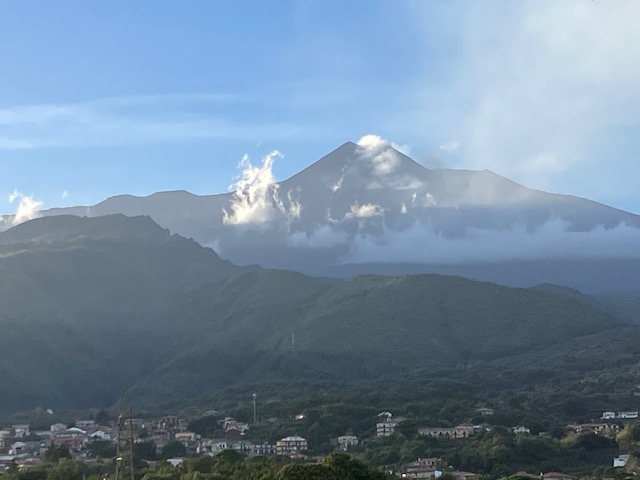
Wisps of smoke on tops of Mt. Etna were seen from miles away. The smoke seemed to increase at night, but it was always present
All this prior to reaching Cefalu, Sicily’s small beach town, where we connected with the young entrepreneur.
He blew kisses our way as he strode away, down the beach, bent over with his wares. Still smiling.
“Optum, optum!” I sent kisses back to him in Turkish, the only words I knew in a language possibly close to his. I may forget parts of our Sicily vacation. I’m not sure why, but I won’t forget him.
In the Sept. 3 New York Times I read”This Summer, I Became the Book-BanningMonster of Iowa” by Bridgette Exman. A former high school English teacher, now the assistant superintendent of curriculum and instruction for public schools in Mason City, Iowa, her column befuddled me.
Exman has some power as an administrator. She doesn’t like book-banning in classrooms and school libraries. What did she do to fight it?
Sure, she has to adhere to legal constraints. Iowa’s “parental rights bill” became effective on July 1, mandating that school libraries must contain only “age-appropriate books” with no description of “a sex act.”
I’m not going to argue with Iowa’s inappropriate law, which harnesses all students in one barn. (Thankfully, I live in Minnesota, whose legislature would never pass such a stultifying bill.)
What befuddles me is Exman’s response to the law.
Did she testify against it?
I don’t care how she instituted the law, which she tells us in detail.
As a former English teacher who “read, enjoyed, and taught many of these books”that are now banned, did she rebel at all?
“There are no winners in the game of censorship,” she wrote. She’s right about that.
I would have preferred to read about her battle to retain one especially beloved (Beloved?) book she hoped students in mostly lily-white Iowa might have benefitted from reading.
Exman reports, “Our district has not had a formal challenge” to a library book in over two decades, indicating that parents must be okay with what their children are reading.
Could she have spoken up for a book that was on the chopping block? Even a sentence or two would have shown the importance of making an attempt.
I understand that Exman’s job may have been threatened if she rebelled.
Did she make a case for a book she felt was important for high schoolers to read? She might have been heard in her school district.
What if more parents went to testify against the bill in the Iowa State Legislature?
Do teachers and parents have the right to speak up? What did she learn about so-called newly assigned parents rights as law? (Parents have always had the right to speak up about their children’s education.)
The last line of her column especially befuddled me: “That’s why we must protect our public schools from the political agendas that are hobbling them.”
Tell me, Ms. Exman, what did you do? That’s what I want to know.
Politicians are clamping down on freedom to learn in schools. Isn’t that why schools exist, or is it to promulgate parents rights bullshit?
There’s no systemic racism in the United States, these politicians claim.
Slavery taught the oppressed some beneficial skills, says the Florida governor and his ilk.
Why tell the truth when it might make children uncomfortable…or perhaps knowledgeable?
Who are these fear mongers kidding?
Aug 23, 2023Fear Is the Watchword in Public EducationA wave of legislation purporting to advance “parental rights” is actually undermining them. In a new report, Educational Intimidation: How ‘Parents’ Rights’ Legislation Undermines the Freedom to Learn, we document nearly 400 state legislative bills that allow extremists to override the views of the majority, micromanage classrooms, and disempower teachers, librarians, and school administrators. And, one governor who vetoed a bill described it as turning teachers into “pronoun police.” (PEN America)
Two books I wish every American adult would read:
The Warmth of Other Suns. The Epic Story of America’s Great Migration by Isabel Wilkerson (2010). It’s a Pulitzer Prize Winner that clued me in to the systemic racism in this country, in the North as well as the South. An important place to start.
The Devil You Know. A Black Power Manifesto by Charles M. Blow (2021). From my favorite NYTimes columnist, hands down. In his latest book he imagines how Southern Blacks can assume more power. Why he moved from New York to Atlanta. Powerful.
Charles Blow has been the most straightforward, incisive, provocative writer through the horrendous rise of he-who-shall-not-be named.
Many teachers are afraid of losing their jobs in repressive-leaning communities. Parents, grandparents, friends of children, I implore you to educate yourselves. Learn real history. Speak up!
I’m so dismayed by the banning and censoring of children’s books I’m going to recommend new titles as often as I have a few minutes: First is The Giver by Lois Lowry, published in 1993.
One of my all-time favorites, The Giver, has been banned, censored, and/or removed from libraries/schools/reading lists more than 11,000 times.
Why? There are some mild sexual references.
But The Giver reminds me of what’s happening in our country today: fascist elements. There’s no other way to say it.
One person in the book is the repository of all history. Damn, you know, the truth is just too uncomfortable. That person is chosen at age 12, like Jonas, is the ONE whose story this tells.
All other twelve year olds receive their life assignment at that time, too. No questioning. Does this sound familiar in our current world? Republican Party members must be totally adherent to he-who -must-not-be-names.
There’s no color or conflict or poverty or unemployment or injustice in Jonas’s world. Just as cult Republicans must be in denial of all their untruths and craziness.
If you’ve never read this fantastically prescient and provocative — YES! — book, I highly recommend it. Let me know what you think (the key word, THINK, WHICH WE NEED SO MUCH MORE OF IN TODAY’S FORLORN SOCIETY.
Popping wild blueberries into my mouth, gorging on the sweetest tiny raspberries ever, is a thrill for this woods woman, this lover of nature.
We’re here for the week with Marc’s family at Northern Air cabins in Ely, Minnesota. A far cry from the exorbitant heat in the Twin Cities. It has rained all week. Last night it poured, offering soothing sounds in the North Woods darkness.
Like in Maine, where I’m from, wild blueberries make me happy. They’re tiny this year, having kept to themselves in the drought. Until this week.
I usually think: Wow, if only I could read books nonstop in a lovely spot, which is what happened during this past week. Finished two books, half-finished two others. As much as I love reading I was a little bored hanging out inside.
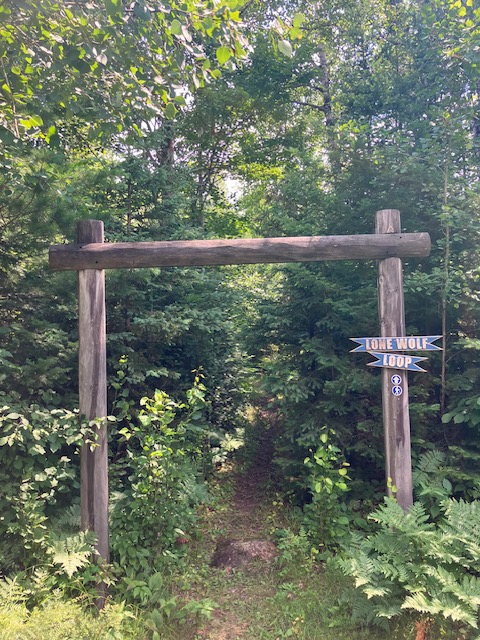
The Lone Wolf Loop, a 45-minute hike on the property where we’re staying, speaks to me. On today’s one-hour hike I experienced a small epiphany.
When I was fifteen, my father was partially paralyzed. He lived in a rehab center in Shelton, Connecticut, about 40 minutes from our Waterbury home. My mother didn’t drive. I illegally drove her twice weekly to see my dad, when I wasn’t working as a cashier at a discount department store or folding children’s clothes in a retail store.
My father was in his sixties and had had a cerebral hemorrhage. Young men paralyzed from motorcycle accidents, or who knows what, filled a number of other beds. This was totally depressing to someone my age, just starting out in life, imagining all that could happen over the years.
My only way out was walking around the rehab center’s wooded property, which harbored broken men like fallen tree branches. Saved me. Saved me. Saved me.
Hiking with imagined wolves following me this morning, it hit me. Being alone in nature, surrounded by ferns of all sizes, assorted leaves blowing in the breeze, and tasty wild blueberry patches, still sustains me.
Writing fewer blog posts, more remiss paying attention to human-induced climate change.
Sure, I worry about my grown kids’ future, my beloved grandchildren, and all of Earth’s children.
What can I do? I ask myself. I write. I’ll tell you about a superb 800 page-plus novel that sheds light on rising sea-level disasters, increased world-wide poverty and starvation, and a world of issues hindering life on this still beautiful blue sphere.
THE DELUGE by Stephen Markley is well worth reading. Too bad it’s so long, scaring many intrepid book lovers off (including my partner).
I’ll admit, I don’t read every word: the prerogative of older readers. We only have so much time to read!
It’s a page-turner that terrifies me: with its crackling scientific minutiae; its sci-fi premonitions; its government ineptitude and political wackos.
Projecting into the next thirty years or so, the book’s possibilities ring true. Perhaps some solutions lie within, too, but that’s not for me to say.
Kate Morris, THE DELUGE’S major protagonist/activist with the wild hair, enthralls me (and her longtime partner). Activists who risk everything always do, but that’s not my approach either.
Is there any hope? I’m intrigued by big carbon and other taxes, by policy geniuses who will stop at nothing, about a possible reordering of political movements.
Will we get there? I don’t know.
What I like best about THE DELUGE is it makes me think. A lot.
Are substitute teachers more dangerous than people carrying guns in public?
Having just submitted a substitute teaching application to the State of Minnesota, which required a background check through finger printing and pages of questions about convictions for drug or sex trafficking, I can’t help but ponder:
Does the State of Minnesota have uniform licensing requirements for gun ownership? No.
Does the State of Minnesota have uniform licensing requirements for substitute teachers? Yes.
Strict licensing requirements for both are essential.
“Minnesota does not require a license to purchase or possess firearms. Persons who wish to purchase a handgun or semiautomatic military-style assault weapon may apply to [their] local chief of police or county sheriff for a transferee permit, although a transferee permit is not required for the purchase or transfer of such weapons” (Giffords.org).
“Thoughts and prayers” will not make a society safer when there are more guns than people.
Stricter gun licensing requirements may be a start. Standing up to the gun lobby may be a start. Appealing to NRA members, who agree that stricter gun licensing requirements are necessary, may be a start.
For more information to help reduce gun violence, please visit: Giffords.org or Momsdemandaction.org.
We’re in deep trouble. Discussing past historical horrors is horrendous in itself. Avoidance and lies only cause more trouble.
Consider the plight of my favorite Constitutional Amendment, the Fourteenth: “No state…shall deny to any person within its jurisdiction the equal protection of the laws.” Ratified in 1868, the essence of the Fourteenth Amendment has been tossed to the wind, although it’s the framework for any semblance of American democracy.
Throwing out the evils of the past will not save democracy. Returning to the restrictions of voting rights will only inhibit progress into a clearly multicultural U.S. future. For those who deny this fact, “the objective is to win the war against progress and to freeze America in a yesteryear image of itself,” writes New York Times columnist Charles Blow.
Yes, it took a century for Civil Rights legislation to finally pass in 1964. Despite the Fourteenth Amendment, the United States still required Congress to comply. For the first time, many Black citizens strode to the polls to vote — unafraid of recrimination — or worse.
The Fourteenth Amendment directed the U.S. Supreme Court to allow same-sex marriage in Obergefell V. Hodges (June 2015).
Truth has disappeared from our body politic like sugar water gulped by hummingbirds. Buzzing around so fast, without any evidence, lies are mistaken for truth. Social media sound bites whiz in and out of our brains.
Back in the 1990s, I told my Mt. Desert Island, Maine, high school students, “If you see me walking down the street thirty years from now what will you say?”
You would yell, Equal protection of the laws!The Fourteenth Amendment!
There is no semblance of democracy without it.
Consider the current plight of my favorite Amendment:
The NYT Magazine’s 1619 Project, which seeks to “reframe the country’s history by placing the consequences of slavery and the contributions of Black Americans at the very center of our national narrative” created a right-wing backlash, instigated by former president Donald Trump’s “1776 Report” touting extreme patriotism, i.e. leaving out Blacks and minorities.
Weren’t we all immigrants who settled here, other than Native Americans? (“The End of History,” NYT, Jan. 15, 2023.)
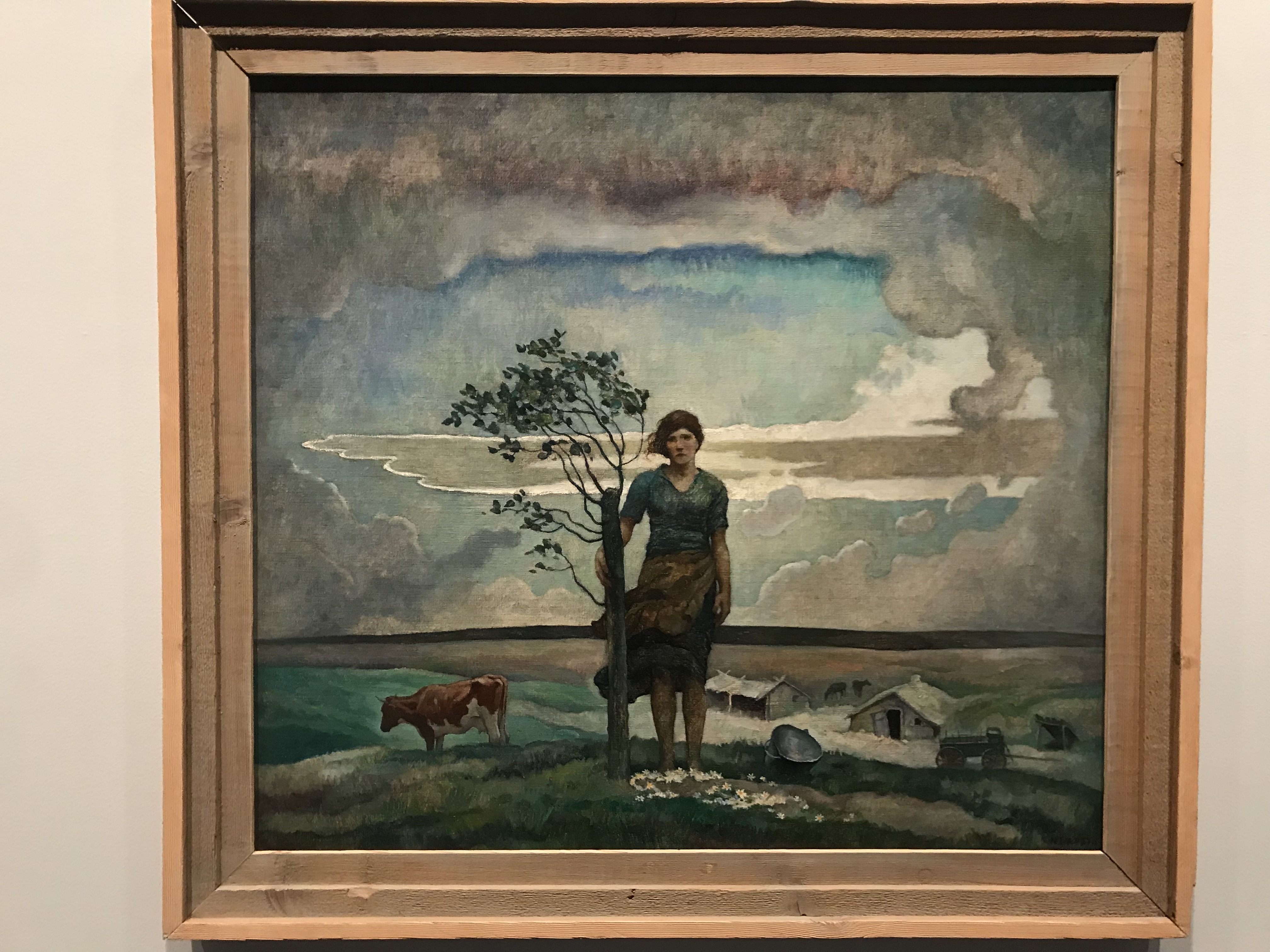
A pioneer white survivor by ONE OF THE WYETHS, Wichita Art Museum
There are bright spots.
At the end of 2022, a federal judge blocked Florida from enforcing the Stop Wrongs Against Our Kids and Employees Act (Stop W.O.K.E. Act) in the state’s colleges and universities.
The order came in a lawsuit brought by the American Civil Liberties Union filed on behalf of seven instructors and one student in colleges across Florida to challenge the Act, which limits how “systematic” [a word critical race theory deniers particularly abhor] racism and sex discrimination can be discussed in schools or workplaces.
In Florida, the ACLU argued the law violated the First and Fourteenth Amendments because it restricts instructors and teachers from learning certain viewpoints.
“Parents and caregivers are children’s first teachers and play a powerful role in determining what children learn about history and in shaping children’s perspectives and our shared future. Discussing the history of slavery in age-appropriate ways can help children understand how that history influences life today.
The Southern Poverty Law Center’s new “Learning for Justice” guide, Talking to Children About the History of slavery in the United States: A Resource for Parents and Caregivers, compiles a list of recommendations for talking about slavery and race with children, offering age-appropriate information and resources to emphasize in conversations and in classrooms.”
Eliminating key parts of our history for bogus reasons — like learning historical truths will make children uncomfortable – is a misuse of the Fourteenth Amendment.
On February 9, the Washington Post’s Laura Meckler reported that the College Board removed the mention of Black Lives Matter and reparations for slavery’s harm to descendants in its African American History pilot program, at the same time stating in a letter to the Florida Department of Education the “the changes were not made in response o Florida’s complaint.”
Meanwhile, more than sixteen states are considering “Do Not Say Gay” laws.
To forge a true democracy, the Fourteenth Amendment must rule. “Democracy sprouts in public schools, where students grapple, together, with our messy history and learn to negotiate differences.” (“What Are Schools For?” NYT, September 4, 2022) No state or jurisdiction may deny to any person “equal protection of the laws.” PERIOD.
I have a lot to say. Some of it is pretty insightful. Not all of it. As a journalist I do more formal writing; this blog will be informal. Let me know what you think



 Tucson Writer Editor